
Industrial Ceramic Parts Manufacturing: A Buyer's Guide
How to specify and source industrial ceramic parts: material trade-offs, forming routes, tolerance economics, ordering checklist and answers for industrial buyers.
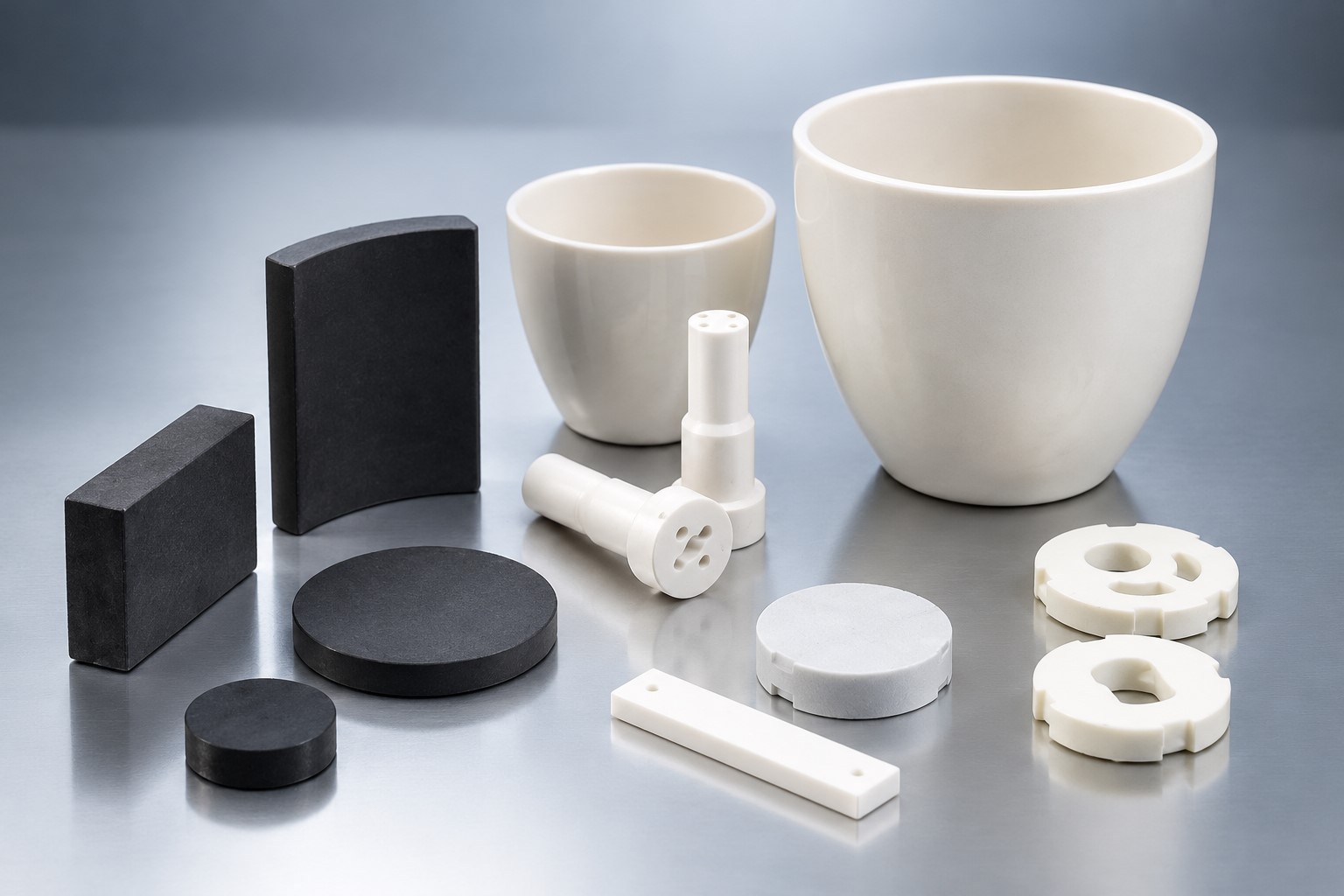
Industrial ceramic parts manufacturing is easy to describe and hard to buy well. A supplier can produce a part that matches the drawing and still fail in service, because the material, the forming route, and the tolerance scheme were chosen for the shop floor rather than for the duty cycle. Buyers who get it right treat the purchase as a specification problem: they define the operating envelope first, then let geometry, volume, and cost decide the process. This guide is written for procurement and design engineers rather than for the kiln operator, and it focuses on the decisions that move price, lead time, and service life. Where it helps, we link to the deeper technical material already published on this site.
In brief: Industrial ceramic parts manufacturing is the industrial route from a refined ceramic powder to a finished, dimensioned component. Material choice, forming method, shrinkage allowance, firing profile, and diamond finishing are specified together, because each one constrains the others. The output is a wear-resistant, heat-stable, chemically inert part for duties where metal or polymer components give out early.
Table of Contents
- What Counts as an Industrial Ceramic Component — and Where It Pays Off
- Choosing Between Alumina, Zirconia, SiC, Si₃N₄ and Cordierite
- The Production Sequence: What Each Stage Locks In
- Matching the Forming Route to the Part
- Four Variables That Decide Whether the Part Fits
- Specification Checklist and Where Orders Go Wrong
- What a Supplier Needs to Quote
- Frequently Asked Questions
- Conclusion
What Counts as an Industrial Ceramic Component — and Where It Pays Off
The dividing line is microstructure control. Pottery and industrial ceramics share a chemistry, but not a specification: an industrial component is built from graded powder so that porosity, grain size, and grain-boundary chemistry repeat from batch to batch. That repeatability is the product. It is what lets an engineer promise a seal will last a maintenance interval, or that an insulator will hold a voltage, without destructive testing every piece. The practical consequence is that advanced ceramic parts are bought on the strength of their failure modes, not their datasheets.
Industrial demand concentrates in five duty types:
- Abrasion under flow: slurry pump liners, cyclone apexes, blast nozzles, and material-handling wear plates.
- Heat cycling: furnace fixtures, burner components, thermocouple sheaths, and welding-adjacent tooling.
- Chemical attack: valve trim, seal faces, and dosing components in aggressive media.
- Electrical duty: standoff insulators, substrates, piezoelectric elements, and vacuum feedthroughs.
- Combined duty: medical and dental parts, ballistic protection, and sensor housings, where two or more of the above apply at once.
The economics are straightforward. A ceramic part usually costs more per unit than the metal part it replaces, and pays for itself by lasting longer, running without cooling, or removing a maintenance stop. When none of those three is true, a ceramic is the wrong answer — and the fastest way to see that is to price the downtime it prevents rather than the part itself.
Choosing Between Alumina, Zirconia, SiC, Si₃N₄ and Cordierite
Materials are usually compared by property tables, which hides the fact that every family has a weakness that decides the application. The table below is arranged around that weakness, because it is normally what rules a grade out.
| Material | Where it wins | Where it struggles | Cost band | Typical industrial part |
|---|---|---|---|---|
| Alumina (Al₂O₃) | Hardness, wear resistance, insulation, predictable supply | Impact and thermal shock at high purity | Low to mid | Seal faces, insulators, pump wear rings |
| Zirconia (ZrO₂, Y-TZP) | Fracture toughness, edge retention, fine surface finish | Creep and phase ageing above roughly 1000 °C | Mid to high | Cutting blades, pins, valve balls, dental parts |
| Silicon carbide (SiC) | Thermal conductivity, thermal shock, abrasion at temperature | Impact loading; oxidation in some atmospheres | Mid to high | Burner tubes, heat-exchanger tubes, seal rings |
| Silicon nitride (Si₃N₄) | Strength with low weight, thermal shock, rolling contact | Cost and limited suppliers | High | Hybrid bearings, rollers, turbocharger parts |
| Cordierite (Mg₂Al₄Si₅O₁₈) | Near-zero expansion under heat; insulates well | Modest strength and wear resistance | Low to mid | Kiln furniture, catalyst carriers |
A single number rarely settles the choice. Two buyers with the same hardness requirement can need different grades, because one part fails by abrasive wear and the other by edge chipping. That is why the operating envelope — temperature, load direction, medium, and cycle — matters more than any catalogue value. Where the duty is unusual, a technical consultation before manufacturing usually costs less than a second tooling round.

For a deeper comparison of the oxide grades, see our notes on zirconia ceramics and high-purity alumina powder.
The Production Sequence: What Each Stage Locks In
Production follows a fixed order, and each stage closes a door that later stages cannot reopen. Reading the sequence this way makes it obvious where a specification should be complete before the first press cycle.
- Powder sourcing and grading. Purity, particle size, and distribution are set here. A substitution made later, even with an “equivalent” grade, changes shrinkage and invalidates the tooling.
- Feedstock conditioning. Binder, dispersant, and lubricant are metered to a recipe. This stage fixes green strength, which decides how much handling the part survives before firing.
- Forming. Geometry, volume, and tolerance are committed to a tool. The forming route also sets the density gradient, and therefore the distortion pattern.
- Green machining. Features that are cheap to cut while the body is soft are shaped now. Anything left for after firing becomes a diamond-grinding operation.
- Debinding. Organic additives are burned out on a slow schedule. Too fast, and trapped gas splits the part; the failure is invisible until the furnace opens.
- Sintering. Density, grain size, and final dimensions are all produced in one thermal cycle. This is the single most expensive stage to get wrong.
- Diamond finishing. Grinding, lapping, and polishing bring critical features to tolerance and set the surface finish that governs friction and sealing.
- Inspection and release. Dimensions, density, and microstructure are verified, with dye penetrant or mechanical testing on critical parts.
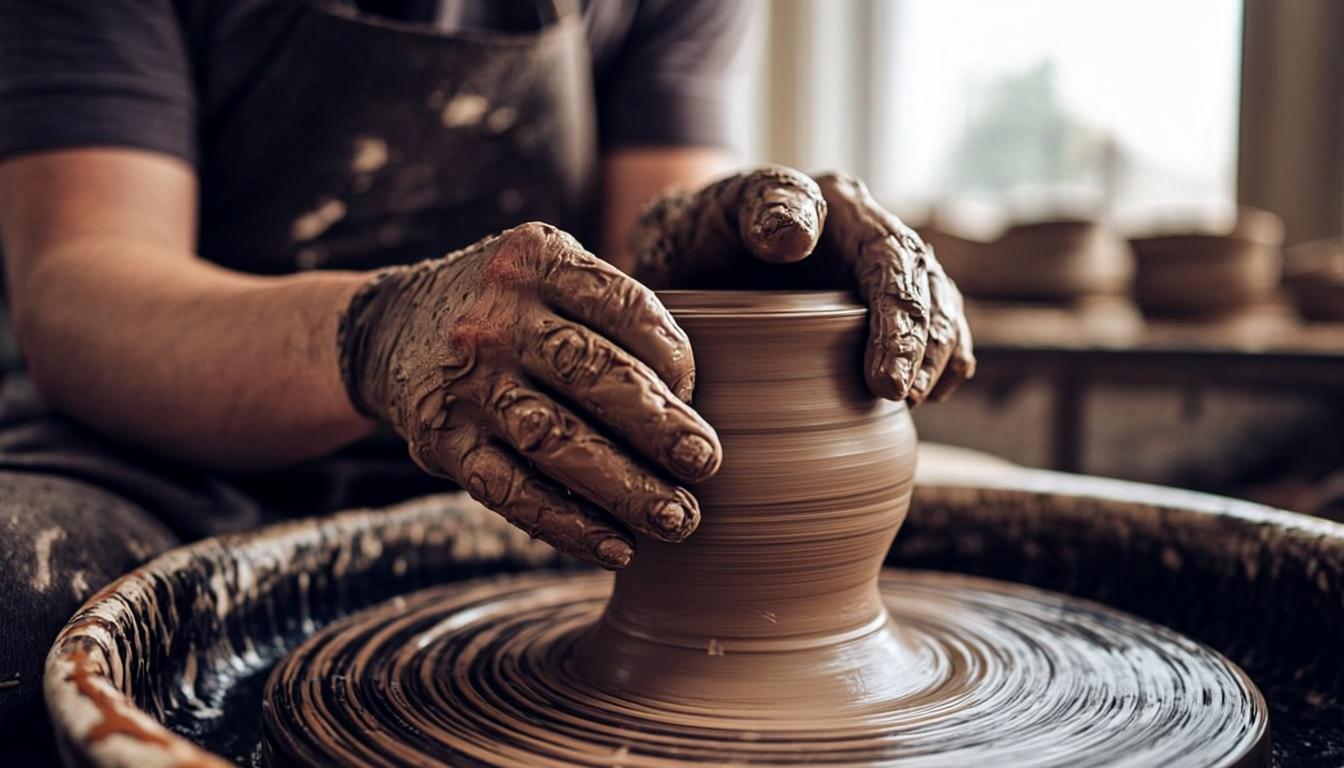
Two of these stages — forming and sintering — account for most of the cost and nearly all of the technical risk, which is why an experienced supplier will push back on a drawing that tries to fix dimensions before those stages are agreed. Densification methods such as spark plasma sintering shift the balance for special grades by shortening the thermal cycle.
Matching the Forming Route to the Part
Six forming routes cover almost all industrial work. Each is described below in the terms a buyer actually needs: the kind of part it suits, the cost driver, and the failure to watch for.
Dry Pressing
A steel die compacts powder along one axis. It is the cheapest route for flat, simple, high-volume geometry.
- Typical part: seal rings, wear discs, tile-shaped liners.
- Cost driver: die cost amortised over volume; cycle time is short.
- Watch out for: density gradients in thick sections, which show up as distortion after firing.
Isostatic Pressing
Fluid pressure compacts the powder from every direction, in a cold (CIP) or hot (HIP) variant. Density becomes uniform, which is the point.
- Typical part: long tubes, thick rings, large blocks, near-net preforms.
- Cost driver: bag and cycle preparation rather than tooling; HIP adds a second thermal operation.
- Watch out for: loose as-pressed tolerance, which pushes work into diamond finishing.
Slip Casting
Slurry is poured into a porous mould and water is drawn out through the wall, leaving a solid layer.
- Typical part: hollow bodies, complex thin-wall shapes, low-volume prototypes.
- Cost driver: labour and drying time; moulds are inexpensive and easily changed.
- Watch out for: variable wall thickness and green strength too low for handling.
Extrusion
Paste is pushed through a shaped die so the emerging profile keeps one cross-section along its length, then cut to size.
- Typical part: rods, tubes, thermocouple sheaths, honeycomb monoliths.
- Cost driver: die cost, which is low; the limit is the geometry, not the volume.
- Watch out for: the impossibility of closed internal cavities, and drying cracks in thick sections.
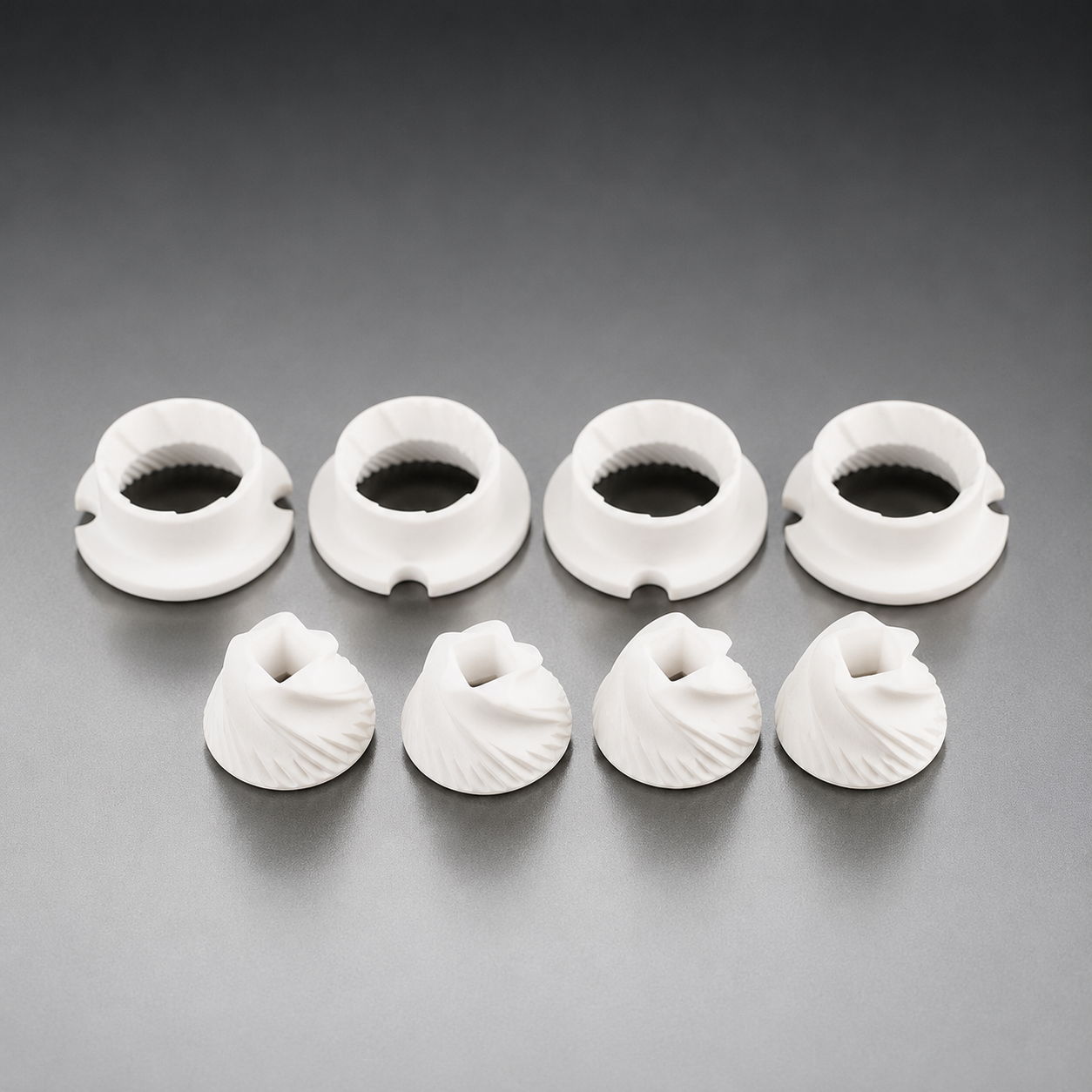
Ceramic Injection Molding (CIM)
Fine powder is compounded with a thermoplastic binder and injected into a precision mould, then debound and sintered.
- Typical part: small, intricate, high-volume parts such as thread guides and ferrules.
- Cost driver: the mould, which dominates at low volume; per-part cost falls steeply with quantity.
- Watch out for: debinding defects, and part size limits that rule out large components.
The route is detailed in our review of ceramic injection molding and on the CIM parts page.
Ceramic 3D Printing
The part is built additively, one thin layer at a time, from a ceramic-loaded paste, slurry, or bound filament. Debinding and sintering follow.
- Typical part: prototypes, one-off fixtures, and organic geometries that no die can produce.
- Cost driver: machine time per part; tooling is effectively zero.
- Watch out for: residual porosity and layer-direction anisotropy, which weaken properties.
Four Variables That Decide Whether the Part Fits
Accuracy in ceramics is the product of four interacting variables. Changing any one of them moves the others, so they are specified as a set.
Shrinkage. A sintered part is smaller than its green body, usually by 12–20% linearly. The figure is a property of the specific powder and forming route, not a universal constant, so it must be measured for the batch. Tooling is scaled by that factor, and uneven shrinkage across a part is what produces warpage.
Tolerance. As-fired dimensions typically hold within ±0.5–1% of the nominal size. Diamond machining tightens that to ±0.01–0.05 mm, with finer limits possible on small features. Each step tighter than necessary adds cost, time, and inspection effort, so limits should trace to a function — a drawing review is the fastest way to spot the ones that do not.
Sintering temperature and atmosphere. Temperature controls density and grain size simultaneously — low leaves porosity, high coarsens the grains. Oxides fire in air; carbides and nitrides need vacuum or inert gas, because oxygen degrades their grain boundaries. The relationship between time, temperature, and density is well established in the literature, including the published work on ceramic sintering.
Particle size. Finer powder sinters to higher density at lower temperature, but costs more and is harder to process. Coarse or agglomerated powder leaves voids that no firing schedule can remove. Particle size is therefore a specification decision, not a supplier’s private choice.
Specification Checklist and Where Orders Go Wrong
The table below turns the usual pre-order questions into a decision aid: each answer rules certain options in and others out.
| Decision | Rules in | Rules out |
|---|---|---|
| Continuous and peak temperature | Alumina, SiC, cordierite at high temperature | Zirconia above roughly 1000 °C in sustained service |
| Dominant failure mode | The tough grades for impact; the hard grades for abrasion | Any grade selected on hardness alone |
| Chemical medium and concentration | Atmosphere-controlled firing and specific phase systems | Grades with vulnerable grain-boundary phases |
| Geometry and annual volume | Injection molding for small complex parts in volume | CIM for large, low-volume components |
| Required tolerance and finish | Diamond finishing where function demands it | Default tight limits that add cost silently |
| Assembly to metal | Matched expansion and metallisation options | Unmatched ceramic-metal joints |
Common mistakes cluster around the same handful of habits:
- Pricing the part instead of the downtime. A more expensive grade that removes a maintenance stop is usually the cheaper choice.
- Copying a metal drawing. Ceramic tolerances, radii, and wall thicknesses obey different limits than machined steel.
- Leaving the grade open. “Ceramic” is not a specification; an open grade hands the decision to whoever quotes lowest.
- Omitting the thermal cycle. Continuous temperature alone is not enough — the rate of change drives thermal-shock failure.
- Skipping the first article. A prototype that is dimensioned and inspected before tooling is committed is the cheapest insurance in the process.
What a Supplier Needs to Quote
A quotation is only as good as the input. To get a price and lead time that survive contact with production, supply the following:
- Drawing and model: 2D dimensions with GD&T plus a 3D file, and the datum scheme.
- Material or duty statement: the grade if fixed; otherwise the operating conditions, so the grade can be selected.
- Thermal conditions: continuous temperature, peak temperature, and rate of change.
- Chemical exposure: medium, concentration, and temperature.
- Mechanical loading: direction, magnitude, and whether it is static, impact, or cyclic.
- Quantities: prototype count, first production batch, and annual demand.
- Finish and special properties: required Ra, porosity limits, and any electrical or optical requirements.
Bring a dimensioned drawing or 3D model, the continuous and peak service temperature, the chemical environment, the dominant load type, the tolerances that matter, the required surface finish, and the expected annual volume. If the grade is still open, describe the duty instead. Sending these together through a cost estimation request returns a usable answer far faster than a partial specification followed by clarification.
Frequently Asked Questions
What are industrial ceramic components used for?
They replace metal and polymer parts where abrasion, heat, or chemicals shorten service life: pump and seal components, nozzles, furnace and kiln fixtures, electrical insulators, bearings, and medical or dental parts. The common thread is a duty cycle that destroys conventional materials faster than a ceramic wears out.
How do I choose between alumina and silicon carbide?
Alumina is the general-purpose choice for wear and insulation at moderate cost. Silicon carbide is preferred when thermal conductivity or thermal shock resistance matters, or when abrasion occurs at high temperature. If impact loading dominates, neither is ideal and a tougher grade such as zirconia or silicon nitride should be considered.
Can ceramic parts be joined to metal?
Yes. Brazing with prior metallisation, shrink fitting, and adhesive bonding are all used, and each requires the joint to be designed alongside the ceramic. The dominant risk is thermal expansion mismatch, which concentrates stress during temperature cycling and can crack the ceramic unless the geometry compensates.
Why is a tight ceramic tolerance so much more expensive than the same tolerance in metal?
Because it is produced by diamond grinding after firing, not by cutting. Ceramic is finished with diamond tooling at low removal rates, and hard, brittle material is slow to measure and easy to chip. Every tolerance tightened beyond what the function needs adds grinding time and inspection cost.
What surface finish can be specified on a ceramic part?
As-fired surfaces are relatively rough, while ground, lapped, and polished surfaces reach progressively finer finishes. The required finish should be tied to the function — sealing, sliding friction, or optical transmission — because each step adds processing time and cost without improving an unloaded surface.
How many parts do I need to order for a custom ceramic part to be economical?
It depends on the forming route. Pressed and machined parts can be viable at low volume, including single pieces. Injection molding carries mould cost that only amortises at higher quantities, so its economic starting point is typically several hundred parts and improves from there.
Conclusion
Buying ceramic parts well is a specification exercise, not a shopping exercise. The grade, the tool, the shrinkage factor, and the finish are chosen together, and a decision made in the wrong order is usually discovered only after a failed first article. Buyers who invest an hour in defining the duty cycle before sending a drawing out for cost estimation consistently get fewer revision rounds and more predictable lead times.
If a component in your line keeps failing under heat, abrasion, or chemical attack, describing that failure in operational terms — how long it lasts, how it breaks, what surrounds it — is more useful than a request for unit prices. Sharing those details with our engineers is the quickest route to a manufacturable specification, and Khat Group’s technologies show the processes we can bring to it.
Further Reading
Khat Group — from material selection to finished ceramic components, in one engineering chain.
Products in this article
Materials and products related to what you read.
 Ceramics
Alpha Alumina (α-Al₂O₃)
High-purity alpha aluminum oxide powder — three purity grades, four particle-size ranges
Khat Group supplies alpha aluminum oxide (α-Al₂O₃) powder in three purity grades (≥99.5%, ≥98%, ≥95%) and four particle-size ranges (<80 µm, <20 µm, <5 µm and <1 µm submicron/nano). Alumina is a versatile engineering ceramic used across electronics, machinery, medical, laboratory, high-temperature systems, and ceramic part fabrication. Custom tubes, rods, plates, substrates, insulators and precision-machined components are supported.
 Ceramics
Yttria-Stabilized Zirconia (YSZ) Powder
High-purity yttria-stabilized zirconia powder — grade KG-ZRO99-20
Khat Group supplies high-purity yttria-stabilized zirconia (YSZ / Y-TZP) powder. Featured commercial grade KG-ZRO99-20 offers ≥99.5% purity with a particle size of <5 µm. Zirconia is a tough engineering ceramic with high strength, wear resistance and excellent surface-finish potential, used for blades, plungers, sleeves, rollers, pins and custom precision components in medical, consumer, industrial and fluid-handling systems.
 Advanced Ceramics
Ceramic Injection Molding Parts (CIM)
High-precision, high-volume complex ceramic components via powder injection molding
Khat Group has developed Ceramic Injection Molding (CIM) technology for manufacturing complex ceramic parts with intricate geometries, tight dimensional tolerances, and excellent surface finish. This process is ideal for high-volume production of small-to-medium components with superior mechanical and thermal properties.
Related reading
 Articles
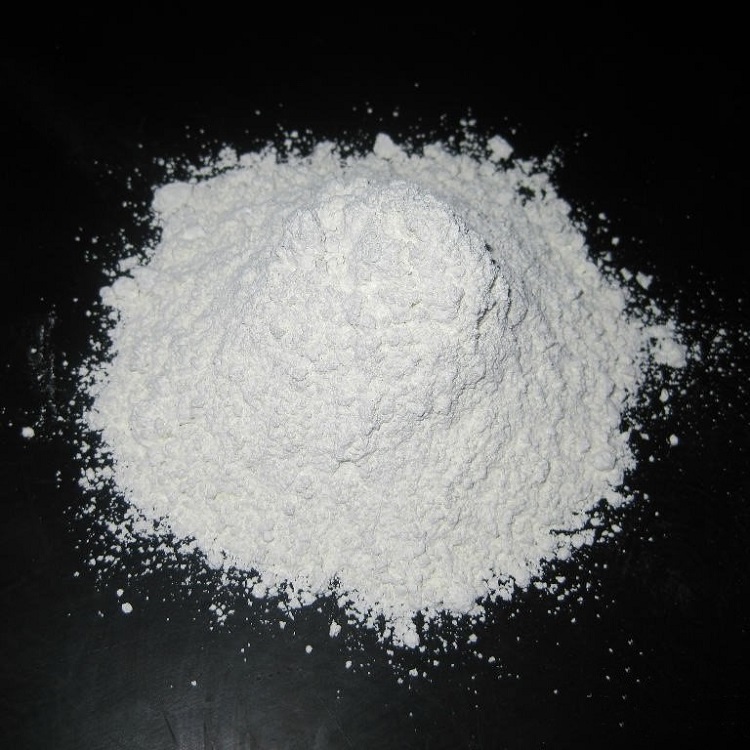
Alumina (Al₂O₃): Types, Properties & Industrial Applications
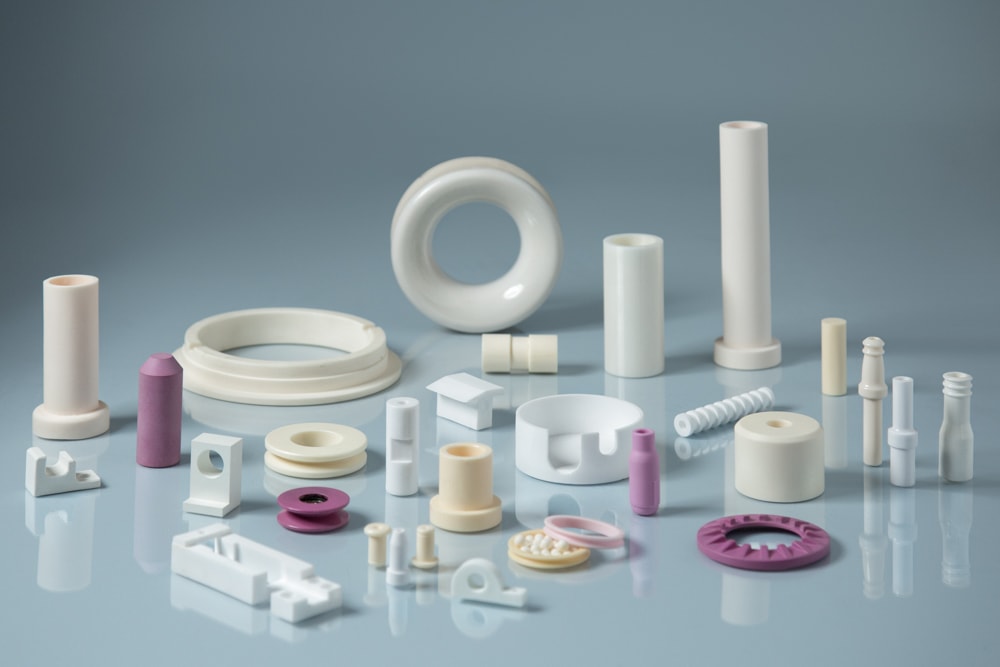
Alumina (Al₂O₃) — crystalline forms (α-alumina/corundum, γ, θ, δ, κ, η), properties (hardness 9 Mohs, MP 2050°C, high thermal/electrical insulation), and applications — abrasives, refractories, electrical insulators, biomedical implants, catalyst supports, armor, wear parts. Grades: smelter, calcined, tabular, fused, reactive.
 Articles
Ceramic Injection Molding (CIM): Comprehensive Technical Review
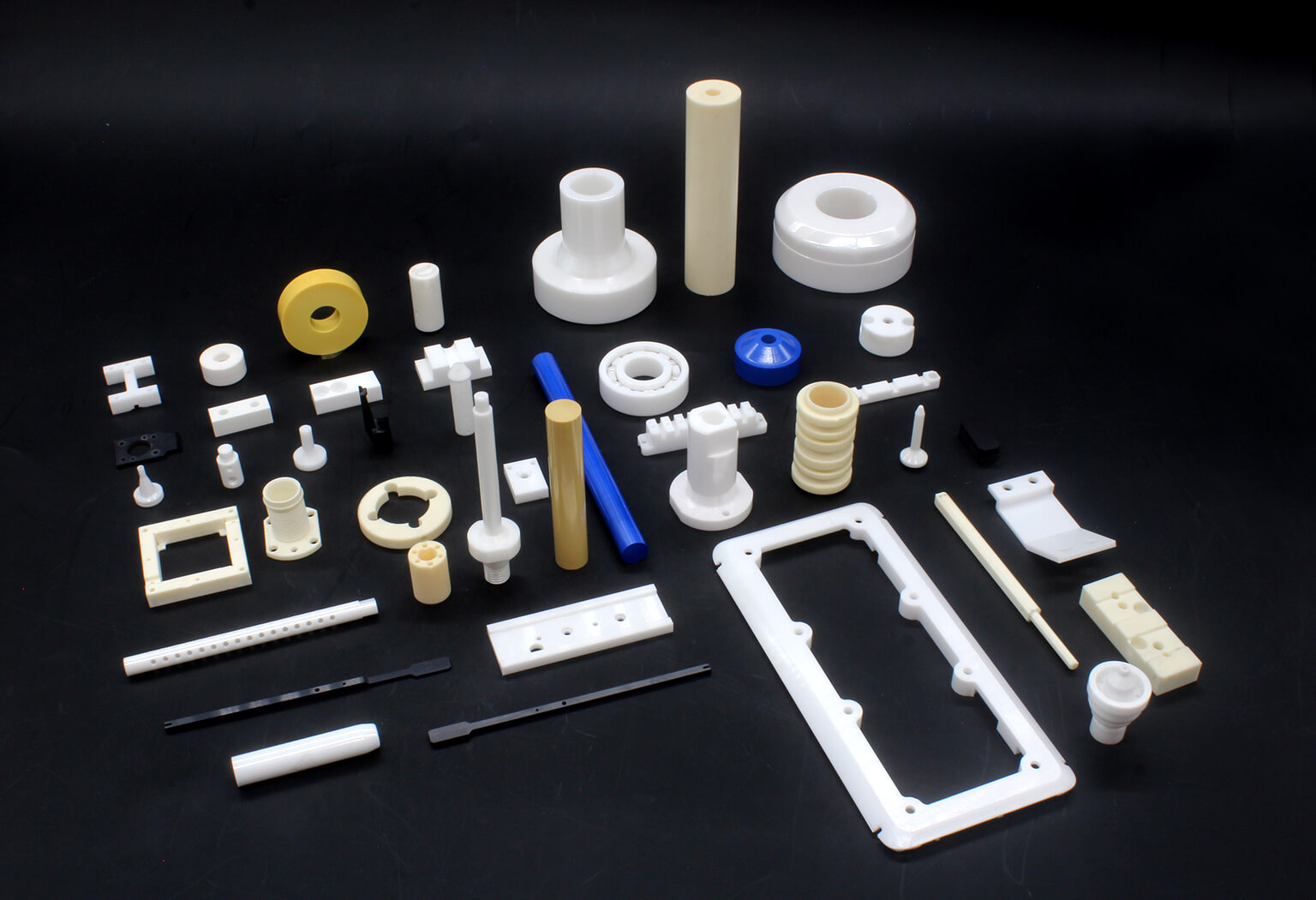
In-depth review of Ceramic Injection Molding (CIM) — materials (zirconia, alumina, silicon nitride), binder systems & debinding, process parameters, quality control, and defect prevention. Essential reading for engineers and students in advanced ceramics manufacturing.
 Articles
Ceramic Injection Molding Technology: Capabilities & Industrial Applications
CIM technology delivers complex, high-precision ceramic components with superior thermal, mechanical, and electrical properties. Applications span automotive, medical, electronics, aerospace, and energy sectors. Khat Group provides end-to-end CIM solutions from design to production.